News
“It Just Blew Us Away” – Survey Reveals Large-Scale Farming by Ancient Menominee Indians
Aug. 7, 2025 — The Menominee Tribe’s historic connection to Michigan’s Upper Peninsula burst into the headlines in June when Dartmouth College researchers announced a surprising discovery north of Green Bay, Wisconsin.
The Dartmouth archaeologists revealed that ancient garden beds at the tribe’s Anaem Omot cultural site were far more extensive than previously thought.
“It just blew us away,” said Prof. Madeleine McLeester, the Dartmouth professor who was a key member of the research team. “We’ve excavated only a handful of ridges, and there are thousands of them.”
The garden beds, or “field ridges,” absorbed sunlight and extended the short growing season of Michigan’s Upper Peninsula, allowing the tribe to grow maize (corn) and other crops in an inhospitable climate.
The unexpected extent of the garden beds was revealed by an aerial survey using laser-enabled 3-D mapping technology.
The findings affirm the Menominee’s oral history of continuous occupation of the Anaem Omot (“Dog’s Belly) location over thousands of years, until the tribe was removed to a reservation in Wisconsin in 1854.
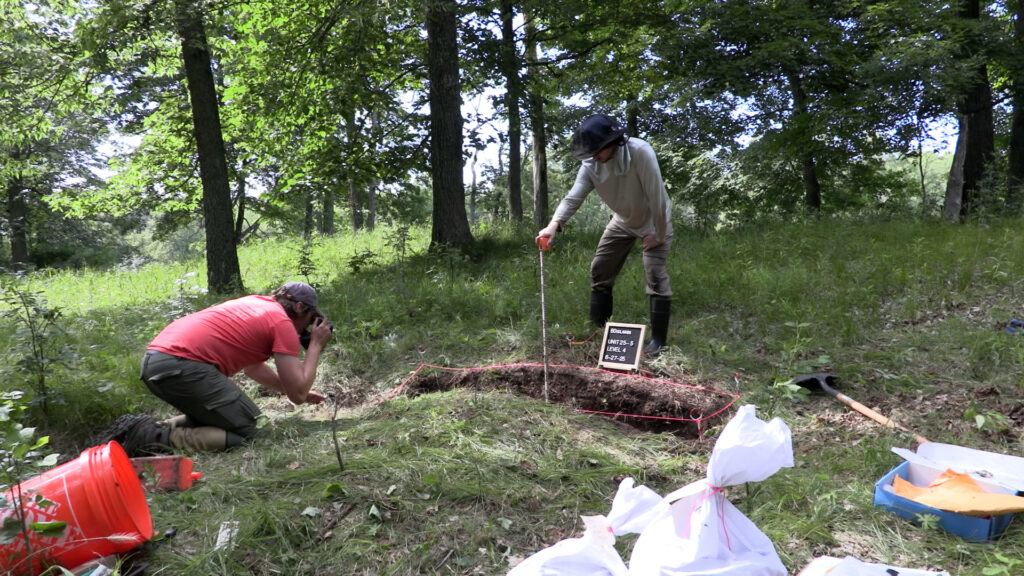
Prof. McLeester and student researchers came back to the Anaem Omot location for more fieldwork in late June. They allowed journalist Mark Doremus to make a record of their painstaking investigation of a research site near the Menominee River.
Watch the video in Clips.
Back Forty Owner Sees Path to Profitability at Its Mexican Mine
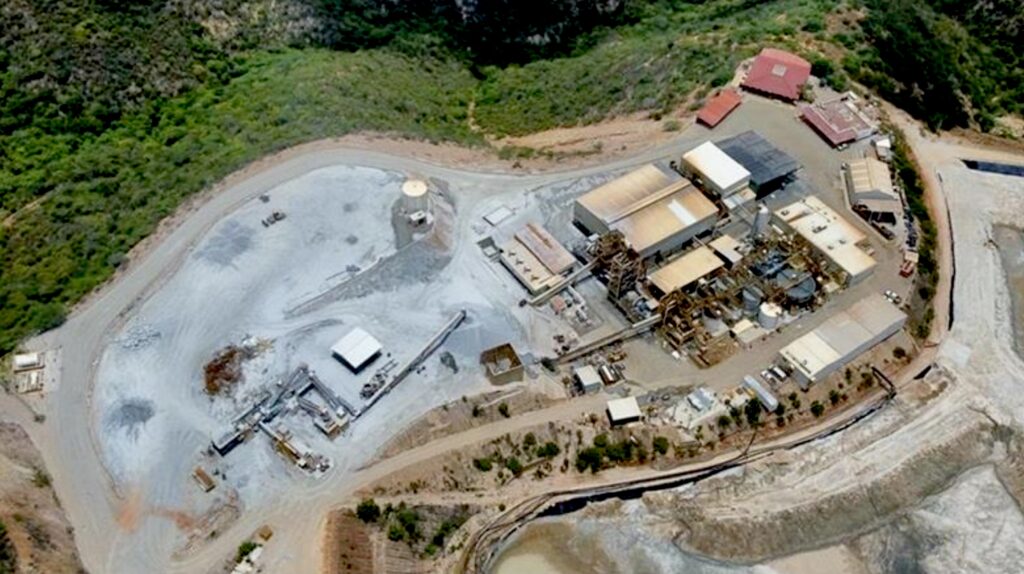
Aug. 6, 2025 — Gold Resource Corp., owner of the proposed Back Forty mine in Menominee County, Michigan, is opening a new mining area, is upgrading equipment at its Don David Gold Mine, and has achieved “positive momentum” toward profitability, CEO Allen Palmiere said today (Aug. 6) in an investor conference call.
The company has lost money for the past 3-1/2 years due to declining ore quality, aging underground mining equipment and ore processing constraints at its mine in the Mexican state of Oaxaca. It lost $11.5 million in the second quarter of 2025, according to its just-released filing with the Securities and Exchange Commission.
However, Gold Resource is opening a new vein system called the Three Sisters, and is beginning to upgrade its mine equipment, Palmiere said.
Improved ore quality at the Three Sisters “will have a significant impact on the mine’s profitability,” Palmiere said. “By the end of the year, we expect 50 percent of our production to be coming from the Three Sisters.”
Despite the apparent good news, the company still faces “substantial doubt about its ability to continue as a going concern,” according to its SEC filing, which means that it may not be able to meet its financial obligations for the next 12 months unless its profitability improves.
Gold Resource spent $371,000 on the Back Forty project in the second quarter of 2025, according to its SEC filing. Expenditures were limited to “project optimization and permitting,” according to the report. A lack of capital, and public opposition to the project, have stalled the proposed open-pit and underground mine west of Stephenson, Michigan, since it was purchased by Gold Resource Corp. in December of 2021.
Ancestral Menominee Indians Left Their Mark at Back Forty Mine Site
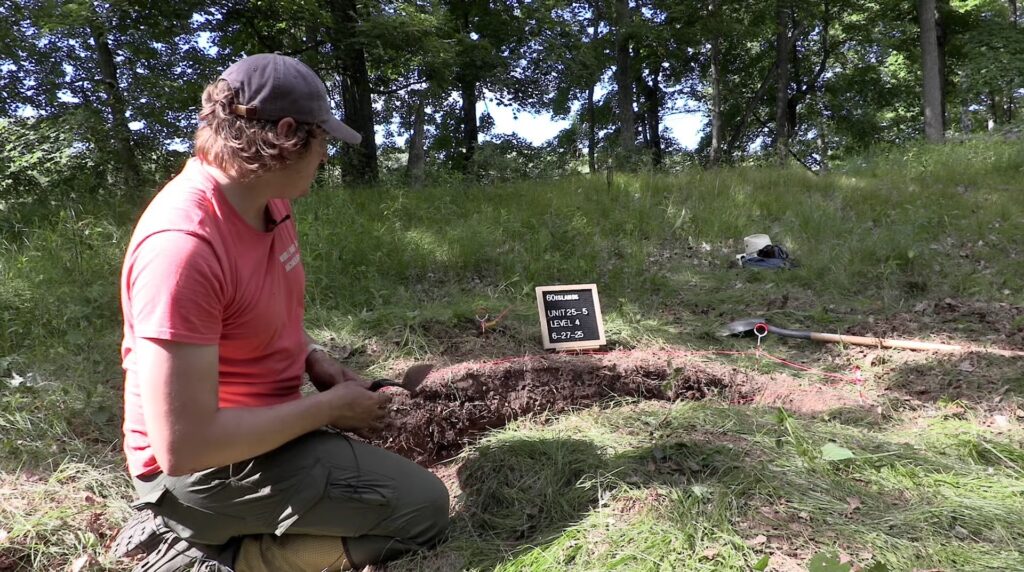
July 17, 2025 — A study by Dartmouth College archaeologists, just published in the journal Science, shows that ancient Menominee Indians farmed successfully under difficult conditions at the Anaem Omot (“Dog’s Belly”) archaeological district north of Green Bay, Wisconsin.
Gold Resource Corporation’s proposed Back Forty mine would be located on a portion of the Anaem Omot site, which is listed on the National Register of Historic Places as a Traditional Cultural Property of the Menominee Tribe.
The Dartmouth study reveals that the area was farmed extensively by ancestral Menominee Indians as recently as 1600 CE. They practiced a sophisticated form of agriculture that used raised garden beds to grow maize (corn) in a place where climate and soil conditions made it an unlikely crop. They also grew beans and squash as part of their food supply, in addition to hunting, fishing and harvesting wild food.
The raised garden beds absorbed sunlight and extended the short growing season of Michigan’s Upper Peninsula. Household waste was used as compost, and rich soil from nearby wetlands was added to promote a better crop.
Aerial surveys using LIDAR (Light Detection and Ranging) technology, conducted by Dartmouth College archaeologists in May 2023, revealed that the Menominee Tribe’s garden beds covered a far larger area than previously suspected.
“We came out and did the LIDAR over the area, and then it just blew us away,” said Prof. Madeleine McLeester, the Dartmouth professor who was lead author of the Science journal report.
“The scale of this agricultural system by ancestral Menominee communities is ten times larger than what was previously estimated,” McLeester said. “We’ve excavated only a handful of ridges, and there are thousands of them.”
“This forces archaeologists to rethink the scale and extent of past Native American agriculture.”
The Menominee Tribe has long recognized the cultural and archaeological value of the site, including the raised garden beds that were documented by the new study.
The fieldwork also revealed burial mounds, a dance ring, and other subtle features that are difficult to spot without LIDAR enhancement.
Such an extensive area of preserved archaeological features is a rare find. Conventional farming and urban development have wiped out most early Native American settlements and agricultural sites.
“These are very delicate features, and so the second a plow goes over them, or even a lot of cattle walk on top of them, they disappear forever and they’re gone,” McLeester said.
“So, this is an exceptionally unique site, and our efforts here are not only to understand how those ancestral Menominee farmers practiced this agriculture, but also to understand what we can do to help preserve these sites and to make sure that we’re documenting them for future generations.”

Back Forty Mine Owner Awash in Red Ink
April 11, 2025 — Gold Resource Corp. (GORO) lost $56.5 million in 2024, the company disclosed in an April 8 annual report filed with the Securities and Exchange Commission. That’s more than twice its 2023 loss of $24.1 million.
Cash on hand has dropped from $6.3 million in 2023 to $1.6 million, according to the company’s Form 10-K annual report.
Gold Resource owns the proposed Back Forty mine in Menominee County, Michigan. It spent $400,000 on the Back Forty in 2024, down from $1.6 million in 2023. That money was spent on “maintaining the project,” according to the SEC filing.
Depletion of Mexican ore deposit is key factor in downturn
Declining ore quality and operational problems combined in 2024 to drive production down and losses up at GORO’s mine in the Mexican state of Oaxaca, the company reported. (The 2024 gold grade, for example, was down 35% from 2023).
Increased downtime due to the age and condition of mining equipment, mechanical issues at the mill, and wet weather also contributed to the 22% year-over-year drop in ore production at the mine, the company said.
Three Sisters is “path forward” to profitability, CEO says
GORO is staking its future on the “Three Sisters” project, located not far from its existing mine site.
The Three Sisters vein system contains significant deposits of gold, silver and other minerals that are a “path forward” to future profitability for Gold Resource Corp., CEO Allen Palmiere said in an April 9 conference call with investors. But more exploration and mine construction would be needed to bring the Three Sisters online.
That means Gold Resource would need a major infusion of capital to get back in the black: $7 million for mining equipment and mill upgrades, and $8 million for initial development of the Three Sisters project, according to the SEC filing.
If GORO doesn’t raise more capital and develop new ore deposits, it may have to shut down its money-losing Mexican operation as early as this summer, according to the SEC filing.
Back Forty mine is a significant financial liability
Financial commitments related to the Back Forty mine were a drag on GORO’s 2024 financial performance.
Osisko Bermuda Limited, an investment firm, put $37.2 million into the Back Forty before Gold Resource Corp. bought it from Aquila Resources, Inc., in the form of a prepayment on future gold and silver production. Aquila agreed to repay the investment by giving Osisko a discount on gold and silver deliveries once the Back Forty went into operation. These contracts for future production are known as “streaming agreements.”
GORO estimates its total liabilities to Osisko under the streaming agreements at $74.4 million.
GORO recently acknowledged an accounting error that substantially underestimated its financial liability to Osisko under the streaming agreements.
The error correction added $8.1 million to GORO’s 2023 losses, and at least $3.1 million to its 2024 losses. GORO does not clearly state the 2024 correction-related loss in its annual report, so the exact impact is difficult to assess.
The Back Forty is collateral under the streaming agreements and could be seized by Osisko if GORO defaults on its obligations.
Gold Resource Corp. was given an opportunity to comment on this report.
Gold Resource Prospecting for Investors with Updated Mineral Assets Report
March 16, 2025 — Gold Resource Corp. has identified enough mineral resources to continue operation of its underground Mexican mine for at least three more years, according to a March 5, 2025, filing with the Securities and Exchange Commission.
The company needs $38.5 million in capital investment to exploit the newly defined mineral deposits, according to the report.
Gold Resource was losing money and was on the verge of bankruptcy last November, because it had exhausted the high-quality mineral deposits at its Don David Gold Mine in Oaxaca, Mexico. Total production at the mine had dropped almost 50% last year from its peak in 2019.
The newly identified deposits, if brought into production, would presumably return Gold Resource Corp. to profitability. The company’s stock has jumped 167% this year.
Gold Resource owns the proposed Back Forty gold mine in Menominee County, Michigan. Development of the project has stalled due to regulatory setbacks and the parent company’s financial difficulties.
Permits for the construction and operation of the Back Forty had been secured by Aquila Resources, Inc., the project’s original owner. However, its wetlands permit was overturned in a contested case hearing, following testimony that Aquila had manipulated test data to reach a predetermined outcome that supported its application.
Aquila announced a few months later that it would no longer defend its permits in court, and would completely redesign the project. Aquila sold the Back Forty to Gold Resource in December of 2021.
Gold Resource Corp. was given the opportunity to comment on this report.
Analyst Says “Stay Away” from Gold Resource Stock
Nov. 14, 2023 — Gold Resource Corp. (GORO) stock “has completely disintegrated” since its third quarter 2023 results were made public last week and should be avoided by all but the most sophisticated investor, said a freelance analyst who goes by the name Fun Trading in a post to the crowd-sourced Seeking Alpha website today.
The company’s stock has dropped more than 25 percent since it released negative third-quarter results on Nov. 6. It closed today at 28 cents per share, down from 40 cents per share when the results were announced.
Fun Trading called GORO’s recent performance “a debacle.” Its cash on hand is severely depleted, “which begs a few questions about the management’s ability to run this company in the best interest of its shareholders.”
Referring to the proposed Back Forty mine on the Menominee River west of Stephenson, Michigan, Fun Trading said: “The most puzzling issue is the reason behind GORO’s management’s decision to purchase such a contentious project from Aquila Resources Inc. on December 10, 2021, for about $24 million on an all-share basis. Even though I don’t think there is any foul play here, it should be thoroughly investigated.”
GORO has spent over $1 million so far this year for preliminary studies on its proposed Back Forty mine, Fun Trading said, and $4 million on exploration at its Mexican mine, which is losing money due to declining ore quality, a strengthening Mexican Peso to the US dollar, increased local power costs, and lower base metal prices.
Marchers Demand Access to Boneyard Road
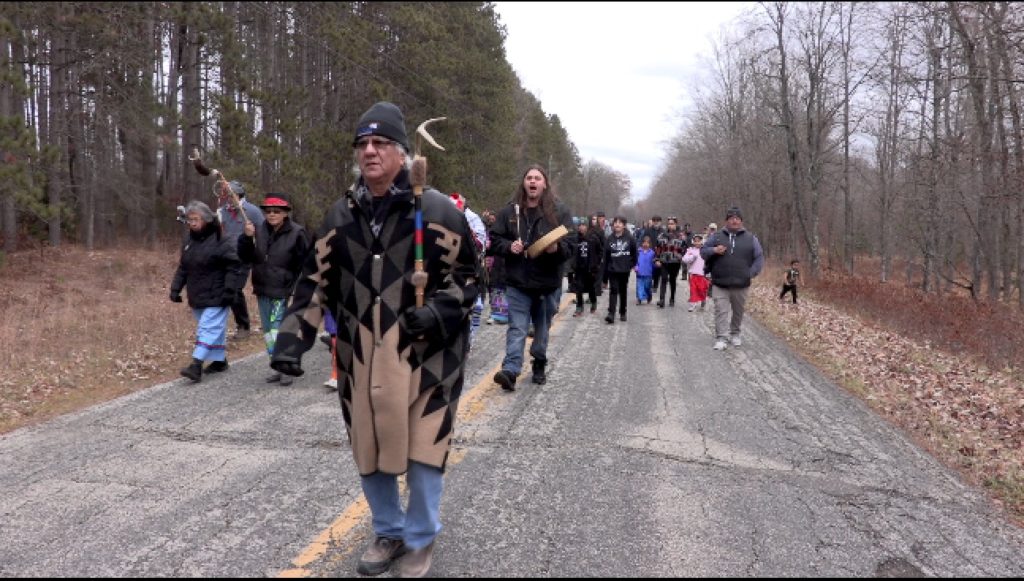
Nov. 11, 2023 — Members of the Menominee Tribe and their supporters walked Boneyard Road today to assert their right of access to cultural sites that were recently included on the National Register of Historic Places.
Gold Resource Corp., which is attempting to develop a mine on a site that is crossed by Boneyard Road, claims the road is private property.
Mine opponents say the road is now, and always has been, a public right of way. To press their point, about 60 men, women and children, Natives and non-Natives, marched over Boneyard Road, which forms a horseshoe starting north of the proposed mine site and exiting to the south.
The road, which is unimproved, got its name because numerous Menominee burial sites are located near it. The area is part of the Anaem Omot, or “Dog’s Belly,” cultural district, where the Menominee Tribe lived for thousands of years on both sides of the Menominee River before they were removed to a reservation in Wisconsin.
Today’s event was billed as a “Walk with Our Ancestors, to honor and protect our ancestral home, the water, and the ancestors who have been here since time immemorial.” It was a grassroots effort that was not formally endorsed by the tribe.
After leaving River Road, marchers eventually reached a gate set up across Boneyard Road by Gold Resource, marking what the mining company considers private property.
Most of the marchers chose to go past the gate and continue up Boneyard Road. After a long hike, they reemerged at River Road under the watchful eyes of two Gold Resource security guards, who remained silent and allowed them to pass.
No law enforcement officers were present and there were no attempts to cite any of the marchers for trespassing.
Total attendance at the event was well over 100 people.
Ore Quality and Income Down at Gold Resource’s Mexican Mine
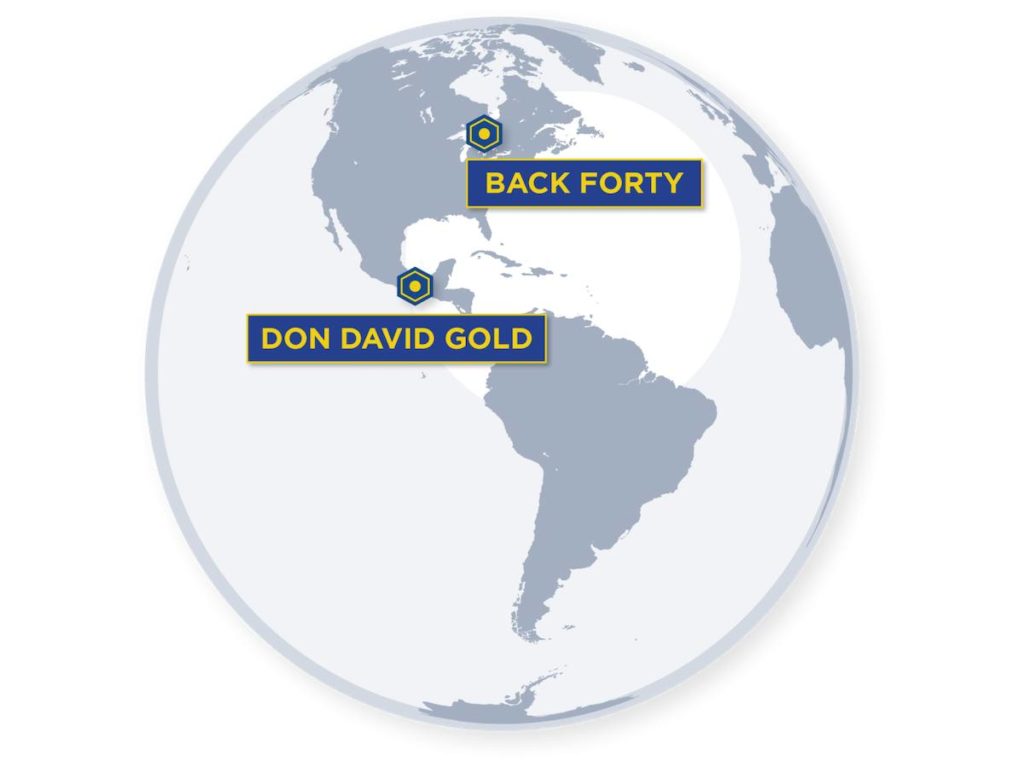
Nov. 9, 2023 — Declining ore quality and lower base metal prices have contributed to a net loss of $13 million so far this year for Gold Resource Corp., which owns the proposed Back Forty project and operates the Don David Gold Mine in Mexico.
The mineral content of ore at the Don David Mine has declined but production costs have remained stable. As a result, the cost per ton of finished product has gone up and the company is currently unable to operate at a profit.
Gold Resource has been drilling test holes in search of higher-quality ore at the Don David Mine and hopes to see improvements next year.
“Our exploration program, which has been our primary use of cash over the last 2.5 years, continues to produce good results, which will result in a growth in reserves and resources increasing the mine life,” said Gold Resource CEO Allen Palmiere during a conference call with investors Nov. 7.
A stronger Mexican peso, in relation to the dollar, and lower prices for copper and zinc, which Gold Resource produces along with gold and silver, have further eroded the junior miner’s bottom line.
The negative cost trends have dramatically affected Gold Resource’s ready cash: it’s down from $22.5 million at the close of the third quarter of 2022 to $6.7 million for the same period in 2023.
As a result, the company is focusing its available resources on bringing the Don David Mine back into profitability and other initiatives are, for now, on the back burner.
“We’re not going to commit to spending a bunch of money on exploration on those other concessions we have,” Palmiere said during the investor call. “We will not spend a lot of money on Back Forty next year. There are a couple of things that we could potentially do that we’re evaluating. But the real focus is ensuring that Don David is operating to the best of its ability to reestablish our bank accounts. And that is our focus for next year.”
The company released its negative third-quarter performance and financial report on Nov. 6, and its stock price dropped 22.5 percent by the close of trading on Nov. 8.
Gold Resource was given the opportunity to comment on this report.